For most of 2026 the sector has been planning on headlines. "Budgets are being cut." "The big four are closing." "Demand is moving to Europe." Each of those is partly true, and each is too blunt to build a 2027 recruitment plan on.
Over the past two months the primary sources have caught up. The Institute of International Education published Open Doors 2025 and the Fall 2025 Snapshot, a survey of 825 US institutions. Immigration, Refugees and Citizenship Canada briefed Parliament, published the 2026 allocations and released its transition binder. The UK Home Office closed its year to June 2026. Read together, they say something more precise than the headlines, and in places the opposite of them.
Recruitment Budgets Did Not Collapse. They Moved.
The most repeated number of the year comes from the Global Survey of International Education Leaders run by Navitas, Nous and The PIE News: more than four in ten universities in Australia, Canada, the United Kingdom and New Zealand plan budget cuts in the next twelve months. It is a real number. It is also a number about four countries, and it is routinely quoted as if it covered the sector.
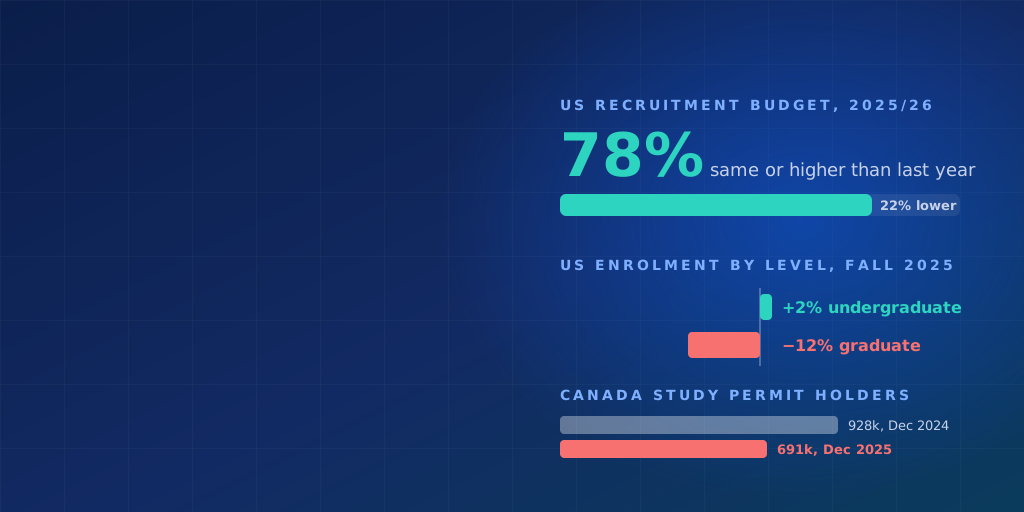
The United States, the largest destination by a distance, reports something different. In the IIE Fall 2025 Snapshot, 84% of institutions say international recruitment remains a priority, and 78% say financial support for it is the same or higher than the year before. Among institutions that grew new enrolment, 71% credit active recruitment initiatives and 54% credit outreach to admitted students.
The more useful signal is inside the cuts, not their size. In the same GISEL survey, the share of universities expecting to spend more on digital platforms and aggregators fell from 54% in 2022 to 22%. The share expecting to spend more on marketing and recruitment staff fell from 61% to 17%. Yet 88% are holding or increasing what they pay agents in commission, and agents account for between 32% and 68% of projected recruitment across key markets.
The budget line that survives a cut is the one that can name the students it produced.
That is the pattern in every dataset this year. Spend is not disappearing. It is migrating from channels that deliver visibility to channels that deliver an attributable enrolment, and it is doing so faster in the countries with caps than in the one without.
Undergraduate Up, Graduate Down: The US Level Split
Open Doors 2025 records 1,177,766 international students in the United States in 2024/25, a record and a 5% rise. The composition is what matters. Undergraduate enrolment grew 4.2% to 357,231. Graduate enrolment fell 2.7% to 488,481. Optional Practical Training grew 21% to 294,253, the tail of several strong graduate years working its way through.
The Fall 2025 Snapshot shows the same split sharpening. Undergraduate enrolment is up 2%, graduate enrolment is down 12%, OPT up 14%, and new enrolment across all levels down 17%. Fifty-seven percent of institutions report fewer new students; among them, 96% cite visa application concerns and 68% cite travel restrictions. Seventy-two percent are offering deferrals to spring 2026 and 56% to fall 2026, which means a share of this year's loss is a delay rather than a defection.
Two further details from Open Doors belong in any 2027 plan. Families are the primary funder for 51.5% of international students, and the institution itself is the primary funder for 19.3%, ahead of every foreign government combined at 1.7%. The scholarship you publish is the second largest source of money in the system. And 92% of institutions say that without OPT, international students would choose another country. OPT is the American argument against a cheaper European master's, for as long as it lasts.
Growth is also geographically uneven. Texas grew 8.4%, Missouri 11.3%, Illinois 7.0%, Ohio 6.1%. California fell 1.1%. The institutions adding international students are increasingly in the interior and the south.
The Markets American Institutions Say They Are Working
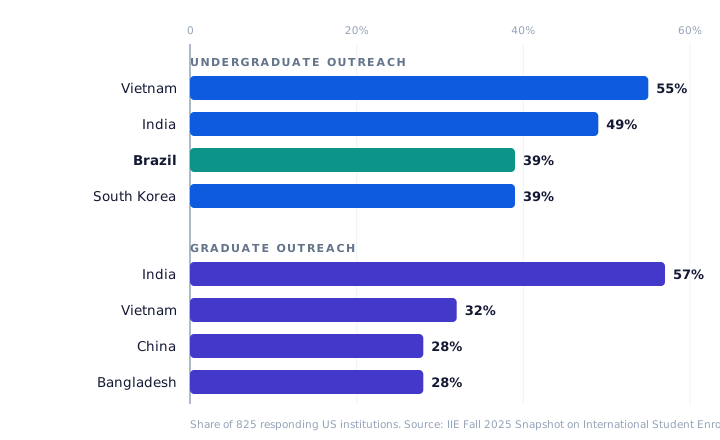
The Snapshot asks institutions which countries they are prioritising for outreach. For undergraduates the answers are Vietnam (55%), India (49%), Brazil (39%) and South Korea (39%). For graduate recruitment they are India (57%), Vietnam (32%), China (28%) and Bangladesh (28%). Latin America appears on the undergraduate list and is absent from the graduate one.
Set that against where the numbers actually moved. Open Doors shows Brazil at 17,277 students (+2.4%), Mexico at 15,652 (+1.2%), Colombia at 10,213 (+0.9%) and Peru at 5,667 (+2.9%), with Colombia and Peru at their largest totals on record. Over the same period, arrivals in August 2025 fell 24% from Asia, 32% from Africa and 17% from the Middle East, and F-1 refusal rates reached 64% for African applicants and 61% for Indian ones.
The reading is not that Latin America is booming. It is that Latin America is holding while the two largest regions are being filtered at the consulate. When an admissions office in the UK can lose its sponsor licence for a refusal rate above 5%, and an American one loses a fifth of its new intake to visa outcomes it does not control, an origin with a low refusal rate stops being a nice-to-have and becomes the scarce asset in the plan.
One more line from the Snapshot deserves attention. Half of US institutions now recruit international undergraduates through US high schools, and a third recruit their own international undergraduates into graduate programmes. The channel institutions trust most is the school and the counsellor who already knows the student. Outside the United States, that channel exists too; it is simply less mapped.
Canada: The Door That Is Open Is the Graduate One
IRCC's own briefing to the parliamentary committee is the clearest statement any government has made this year about what it wants and does not want. The numbers below are the department's.
| What IRCC reports | Figure | What it means for recruitment |
|---|---|---|
| Study permit holders | 928,430 in December 2024 to 691,215 in December 2025 | A quarter of the stock gone in one year, with new arrivals down 61%. |
| New arrivals planned | 155,000 in 2026; 150,000 in 2027 and 2028 | No rebound is budgeted. The 2027 cap is set this autumn with the levels plan. |
| Refusal rate, new permits | 59% January to September 2025, up from 49% | Approval near 58% is expected in 2026 because provincial attestation letters filter applicants first. Pre-qualified applicants clear; volume does not. |
| Master's and doctoral students | Exempt from attestation letters at public institutions from 1 January 2026; about 49,000 permits; doctoral files processed in 14 days; C$1.7 billion over 13 years for research talent | The one segment the government is actively recruiting for. Canadian graduate programmes are a growth product in 2027; colleges and undergraduate volume are not. |
| Proof of funds | C$22,895 from September 2025, indexed annually | Financial capacity is now a stated integrity measure, not a formality. |
| Letter-of-acceptance verification | Over 10,000 fraudulent letters flagged in 2024, 4,900 in 2025; penalties for non-compliant institutions from spring 2026 | The institution carries the compliance risk for its pipeline. |
| Post-graduation work permits | Language requirement and in-demand fields; new permits down 20% | "Study, work, stay" is no longer a message that can be made generically. |
| Francophone pilot | 65% approval, against 34% to 39% historically for the same countries | A quietly open lane for French-speaking applicants outside Quebec, and Quebec itself holds the second largest allocation at 93,069. |
Latin America is a small and shrinking source for Canada: Brazil 7,015, Mexico 8,375 and Colombia 6,775 permit holders in 2024, each down between 26% and 35%. The sector's own outlook cites the region for continued growth in language programmes and pathways, which are the segments the cap hits hardest. For Canadian universities, the defensible 2027 pitch to Latin America is a master's or a doctorate at a public institution, with the funds documented.
The Rest of the Map in One Table
| Destination | Official signal | Read for 2027 |
|---|---|---|
| United Kingdom | 383,455 sponsored study visas in the year to June 2026, down 11% on the year and 41% from the 2023 peak. Graduate Route falls to 18 months for applications from 1 January 2027. Levy of £925 per international student from 2028/29. | Still large. Selection by refusal rate and compliance, which favours origins that clear. |
| Australia | National Planning Level held at 295,000 for 2027, no provider allocated fewer places than in 2026. Offshore higher-education refusal reached 32.5% in 2025/26; visa fee A$2,500. | Predictable, and predictability is now an advantage. Managed growth, not expansion. |
| Germany | Around 420,000 international students; three in four universities report stable or rising numbers. Roughly 4% of bachelor's programmes taught in English against about 18% of master's. | A graduate destination for international families. Public universities recruit through DAAD, not through paid presence. |
| France | About 445,000 international students, target 500,000 by 2027. Proof of funds raised to €877.50 a month. Africa supplies 53% of the total. | Growth by national strategy and by corridor, mainly francophone. |
| Spain | Over 100,000 international students, an EduBridge fast track, 30 hours of work a week and a 12-month post-study job-search permit. | The natural European home for Spanish-speaking Latin America, mainly for price-sensitive families and for master's. |
| South Korea | 314,397 international students in February 2026, target met two years early. Vietnam 115,131, China 78,529, Uzbekistan 20,609, Mongolia 18,992. | Recruits its own region. Not a competitor for Latin American or African demand. |
| Malaysia | Applications up 26% in two years; China the largest source at 33,216 applications in 2024, then Bangladesh, Indonesia, Pakistan and India, with the Middle East and North Africa fourth by region. | Asian and MENA demand at a lower price point. Same conclusion as Korea. |
| New Zealand | 83,700 international students, target 119,000 by 2034; June 2026 was the strongest month of student visa approvals since 2016. | Small, open and growing, with capacity as the limit. |
What This Means for Your 2027 Plan
- Budget by outcome, not by channel. Every survey this year says the same thing: the money that survives is the money that can name the students it produced. Ask each line item for its enrolments, not its impressions.
- Write two plans, one per level. The US is growing at undergraduate and shrinking at graduate. Canada is closed at undergraduate and open at graduate. Continental Europe recruits almost entirely at master's. A single "international" target hides all of that.
- Treat low-refusal origins as a strategic asset. Latin America is holding while Asia and Africa are being filtered. If your sponsor licence, your yield or your compliance reporting depends on refusal rates, weight your outreach accordingly.
- Requalify the pipeline against proof-of-funds thresholds before the visa stage. Canada at C$22,895, France at €877.50 a month, the UK and Australia by outcome. A family that qualified in June may not qualify in September, and the number moved, not the student.
- Work the admitted pool as hard as the prospect pool. Institutions that grew credit outreach to admitted students more than any tactic except active recruitment. With deferrals at 72%, the 2026 admit is the 2027 enrolment.
- Use the counsellor channel outside your home country. Half of US institutions recruit through high schools at home. The same relationship, with a counsellor who knows the student, the grades and the family budget, exists in the origin markets and converts on the same logic.
- Sell Canada as a graduate destination and Europe through its agencies. The Canadian exemption is explicit. The European public university does not buy presence; DAAD, Campus France, SEPIE and their peers do.
FPP Insight
The headline of 2026 is scarcity. The data says selection. Governments are not shutting the door so much as narrowing it to the applicants they can verify and the levels they want, and institutions are not spending less so much as spending where they can prove a result.
For a recruitment team, that is better news than the headline, because selection can be planned for and scarcity cannot. The plan has three ingredients the primary sources keep pointing to: the right level for each destination, an origin that clears the consulate, and a way to show the finance office an enrolment rather than a lead.
We will keep publishing the primary numbers as they land, including the Canadian 2027 cap this autumn, the UK Graduate Route change in January and Open Doors 2026 in November. If the tables behind this article would help your own planning, they are available on request.