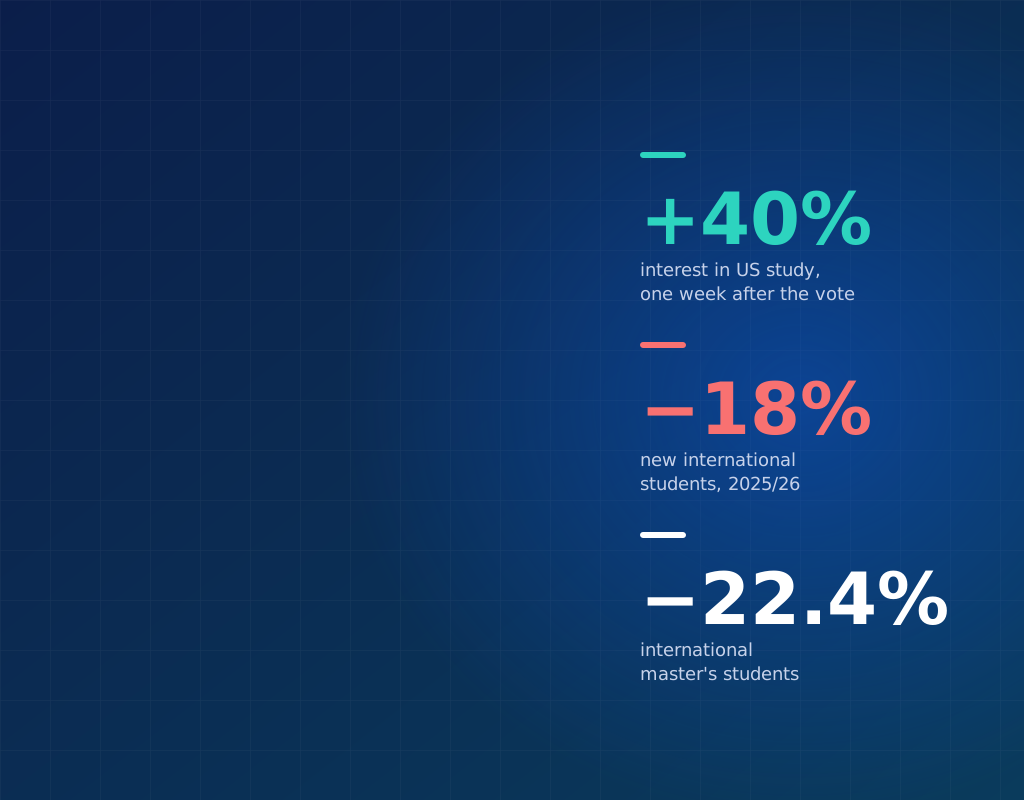
Studyportals reported the figure on 10 November: views of on-campus programmes at US institutions on its platform were 40% higher on 8 November than on 1 November. It followed nearly two years of decline. The company published no methodology and no breakdown by country, and its chief executive was the first to say that the difficulty is converting interest into enrolment. It is one week on one website. It is also the first upward movement in US demand that anyone has measured since early 2025, and it arrived in the middle of application season.
A week later the Institute of International Education published Open Doors 2026. It describes the year the spike is reacting to, and it is the more useful document, because it shows exactly where the United States lost students and where it did not.
What Has Not Changed
The measures that reduced enrolment are executive actions. An election for Congress does not touch them directly. From January, Democratic majorities in both chambers can hold hearings, issue subpoenas and attach conditions to appropriations; they cannot override a veto. Xiaofeng Wan, a former dean of international admission, described it in University World News as a turning point and not a reversal: more scrutiny and a higher political cost for new restrictions, with the existing ones intact until the executive, the courts or a bipartisan deal removes them.
| Measure | Status on 17 November 2026 | What would change it |
|---|---|---|
| Entry and visa restrictions for nationals of 39 countries, including a suspension of new student visas for part of the list | In force since 1 January 2026 | The President or the courts |
| Social media review and mandatory interviews for student visa applicants | In force since June and September 2025 | State Department practice |
| Rule replacing "duration of status" with a fixed stay of up to four years | Vacated by a federal court on 16 November 2026 | An appeal by the government, not yet filed |
| Guidance restricting internships during study (CPT) | Suspended by a federal court on 17 November 2026 | The outcome of that case |
| Proposed fee of US$70,000 on initial post-study work authorisation (OPT), paid by the institution | Proposed on 8 October 2026; comments closed 9 November | Withdrawal, a final rule, or litigation |
| US$100,000 payment for new H-1B petitions | Extended to September 2027; collection blocked by two courts, under appeal | The appeals courts |
Sources: NAFSA, the Federal Register, university notices and court reporting. Several of these rulings are days old and can be appealed.
Read the table as a recruiter and two things stand out. The relief of the last fortnight is real, and it came from judges. And the single measure that matters most to a master's applicant from India, the cost of working after graduation, is still an open proposal. That is the pipeline the spike has to pass through.
Where the United States Actually Lost Students
Open Doors counts 1,146,000 international students in 2025/26, down 3%, the first fall since the pandemic. The headline hides three different stories.
| Open Doors 2026 | Change on the year before | What it tells a recruiter |
|---|---|---|
| New international students | Down 18%, after a 7% fall the year before | The stock is held up by students already there; the flow is what fell |
| Master's students | Down 22.4% | The level most exposed to the price and to work rights |
| Undergraduates | Down 0.3% | Families planning four years ahead did not leave |
| Doctoral students | Up 3.1% | Funded study is behaving differently from fee-paying study |
| India | Down 6.5%, the first fall in six years | The master's market in one country explains much of the total |
| China | Down about 4% | A slow decline, not a collapse |
| Brazil, Vietnam, Nepal | Up 4%, 6.5% and 16.5% | Growth exists, and it is outside the two largest markets |
Source: IIE, Open Doors 2026, as reported by ICEF Monitor, The PIE News and Higher Ed Dive on 16 November 2026.
The Fall 2026 Snapshot, a survey of 809 institutions, extends the picture: new enrolments down a further 15%, graduate down 15%, undergraduate down 3%. Institutions that lost students blamed the visa process (88%), travel restrictions (70%), students choosing other countries (60%) and cost (45%). And 81% say international recruitment remains a priority. In Arizona the three public universities together enrolled fewer students this autumn for the first time in a decade, and the University of Arizona has about 18% fewer international students than a year ago and expects US$66.8 million less in tuition than it budgeted.
The undergraduate market barely moved. The master's market fell by more than a fifth. A spike in interest means something different in each.
The Students Did Not Simply Go Elsewhere
The comfortable reading of the last two years was that students lost by the United States went to its competitors. This month's figures do not support it. In the United Kingdom, sponsored study visa applications fell 20% in the year to October, to 349,900. The Russell Group warned that the volatility shows no sign of slowing, and a survey of British business schools found 69% reporting lower international enrolment this year, against 35% a year ago. Canada confirmed on 5 November that it will hold new student arrivals at 150,000 a year through 2029, and analysts expect far fewer permits than that to be issued in 2026.
Three of the four largest English-speaking destinations are now smaller, by policy or by its consequences, than they were in 2023. Some of the demand moved to Europe and Asia. Some of it stayed at home, in the campuses and partner programmes that foreign universities are opening in the student's own country. And some of it is simply waiting, which is what a 40% jump in one week looks like.
The Markets That Held
The same data shows where demand is steady. Brazil is the clearest case in our own markets. Students from Brazil in the United States rose 4% in Open Doors 2026. Student visas issued to Brazilians fell by about 1% in 2025, against a fall of about a third for all nationalities. The annual survey of Brazilian agencies by BELTA found that higher education is now the goal of 23.6% of students going abroad, up from 12.7%, while language courses as the main goal fell from 38.6% to 25.8%. Spain, Italy and the United Arab Emirates moved up the list of destinations. The candidate is changing from a language student to a degree student, and is looking at more countries than before.
That profile, a family that plans, pays for an undergraduate or master's degree and compares four destinations, is the one that did not leave the American market and is the one most likely to act on better news. It is also the one that every other destination is now trying to reach.
What to Do Before January
- Treat the spike as a lead, with a deadline. Interest generated in November becomes an application by January or it becomes nothing. Answer enquiries from the last three weeks first, extend a deadline if your institution can, and tell the applicant plainly what has and has not changed.
- Separate your undergraduate and master's forecasts. They are behaving like two markets. Undergraduate demand held through the worst year on record. Master's demand depends on a work-rights rule that is still a proposal. One number for "international" will be wrong for both.
- Brief your leadership on the court rulings, with dates. Duration of status was restored on 16 November and the internship guidance was suspended on 17 November. Both can be appealed. A provost who hears it from you with the caveat is better served than one who hears it from a headline without it.
- Put visa outcomes next to admissions outcomes. Institutions that lost students named the visa process before anything else. Track issuance and refusal by market for your own admitted students, and move budget toward the markets where an offer still becomes an arrival.
- Do not wait for India to return before working the markets that held. Brazil, Vietnam and Nepal grew in a year when the total fell. Latin American families who plan a degree abroad are deciding now, with more destinations on the table than they had two years ago.
- If you recruit for the UK, Canada or Europe, expect the comparison. The family that reopens the American file will hold it against yours. Have the answer ready on cost, on the visa and on work after graduation, with this month's figures and not last year's.
- Be present where the decision is made. A week of search data shows that the mood can turn in days. Conversion still takes a conversation, with the student, the parent and the school counsellor, in their city.
FPP Insight
For two years international recruiters have planned around bad news from Washington, Ottawa, London and Canberra at once. November brought the first evidence that the mood can move the other way just as fast. It would be a mistake to budget on it. It would be a larger mistake to ignore it, because the families who are reconsidering this winter are the ones who enrol in 2027, and they will choose among whoever is in front of them when they do.
The rules will be argued in courtrooms and committee rooms through 2027, and nobody can promise a student how they end. What an institution controls is whether it is known in the schools and cities where the decision is taken, whether it answers quickly, and whether it tells the truth about what is certain and what is not. A 40% spike is not a pipeline. It is an opening, and openings are filled by the people who turn up.