International recruitment has always assumed that the student moves. The brochure, the fair, the agent and the visa all exist to carry an eighteen-year-old or a graduate across a border. For a decade the other model, taking the degree to the student, grew quietly alongside it. In the figures for 2024-25 it overtook it, at least for the United Kingdom, and the reasons it did so are the same reasons your conversion rates fell.
This matters to a recruiter in two ways. If your institution is building provision abroad, the new campus is a recruitment problem before it is anything else, and the early evidence from India says so plainly. If your institution is not, then the student you are trying to bring to your home campus now has a British, Australian or American degree on offer forty minutes from home, at about a third of the price.
The Crossing, and the Footnote It Needs
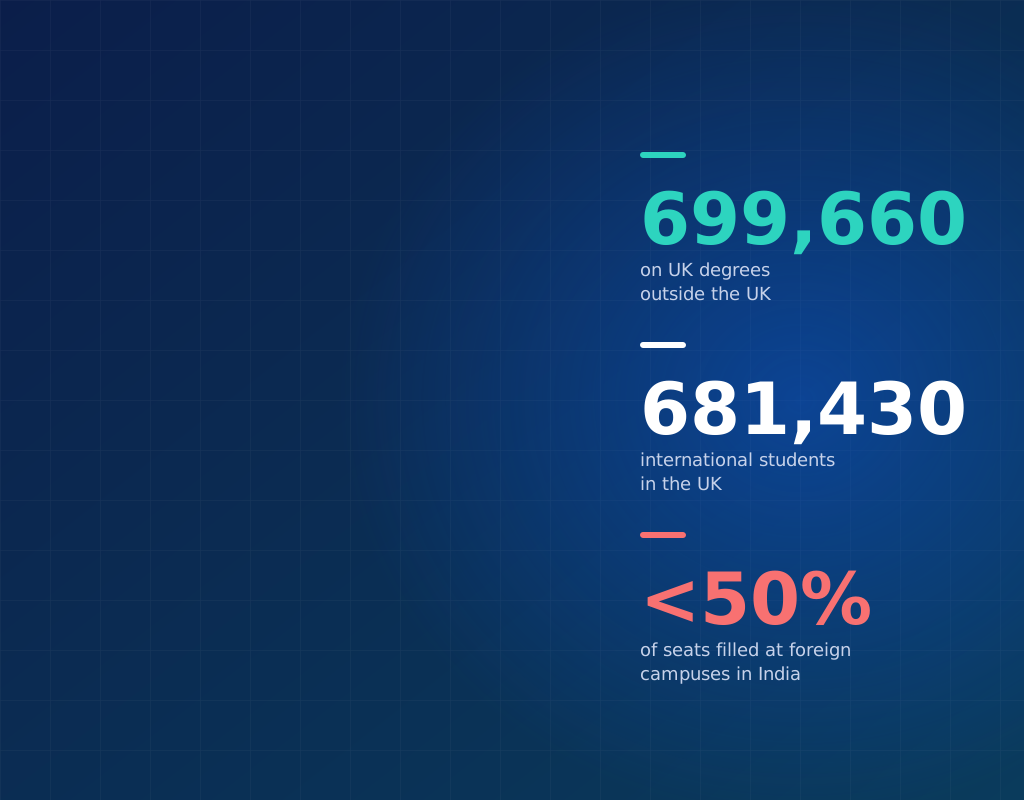
Universities UK International published the eleventh edition of its count on 30 September. It found 699,660 students studying wholly outside the UK for a UK award, 7% more than a year earlier and 36.6% more than in 2020-21. In the same year, international students in the UK numbered 681,430. Jason Lane, who co-founded the Cross-Border Education Research Team, and Janet Ilieva of Education Insight called it a first when they wrote about it in University World News on 4 November.
Before that sentence goes into a board paper, add the footnote. The figures published by the statistics agency HESA in January show the opposite order for the same year: about 670,000 studying abroad for a UK award and 685,565 international students in the UK. The two counts differ in coverage, and the authors themselves say the comparison is not like for like. What both data sets agree on is the direction. Students in the UK are down about 10% from the 2022-23 peak. Students on UK degrees abroad are up by more than a third in four years. Whether the lines crossed in 2024-25 or will cross in 2025-26 is a detail.
| Where UK degrees are studied abroad, 2024-25 | Students | What is happening |
|---|---|---|
| Mainland China | 96,100 | Up 7.5% in a year; about four in five through partnerships |
| Sri Lanka | 69,445 | Second largest host, almost entirely partner-delivered |
| Malaysia | 47,785 | A mature market of campuses and partners |
| Egypt | 39,875 | Up 24.4% in a year |
| Greece | 35,295 | Double-digit growth; new licences for foreign universities are being tested in court |
| South Asia as a region | 124,500 | Up 76.9% since 2020-21, the fastest of any region |
Source: Universities UK International, as reported by The PIE News, Times Higher Education and Educationist on 30 September 2026. Country figures were reported by one of the three and should be checked against the report before reuse.
Why the Classroom Moved
Lane and Ilieva borrow the language of trade. Education can be exported by having the customer travel, which trade negotiators call consumption abroad, or by setting up where the customer lives, which they call commercial presence. For a decade the two grew together. Since 2022-23 they have moved apart, and the authors list why: Canada's cap on study permits, the fall in new enrolments in the United States, the United Kingdom's ban on dependants and tighter compliance rules for sponsoring universities, Australia's planning levels. Their comparison is with Japanese carmakers who built plants in the United States in the 1980s when import limits arrived.
They add the caveat that separates a university from a carmaker. A car built abroad earns the company roughly what a car built at home does. A student taught abroad earns a university far less than a student who pays international fees on the home campus, and the fee is usually shared with a local partner. The University of Michigan ended its joint institute in Shanghai in 2025 and Texas A&M is closing in Qatar. Provision abroad is a different business, with different margins and different risks, not the old one relocated.
Seven in ten students on a UK degree abroad are taught by a local partner. Fewer than one in fifteen ever sets foot on a branch campus.
- 70%Taught by a local partner institution
- 23.4%Distance and online learning
- 6.6%At a branch campus of the UK university
India: Thirteen Universities, Half the Seats
India is where the bet is being placed most visibly. Since the regulator opened the door, thirteen foreign universities, all required to rank in the world's top 500, have begun teaching there: seven British, five Australian and one American. Between them they offer 91 programmes and 2,730 seats for 2026-27, across Mumbai, Bengaluru, GIFT City, Delhi and Chennai. Seven more have been announced for 2027-28.
A study published in July by DrEducation Research, whose author Rahul Choudaha formerly helped run one of these campuses, found that only seven of the thirteen had published any enrolment figures. He estimates that fewer than half the seats are filled, and has put the total at no more than 1,500 students. One Australian campus in Bengaluru enrolled 60 against a target of 120. A British campus in Mumbai was reported at less than half of its target of 250.
| Annual undergraduate tuition | Average | Read as |
|---|---|---|
| Leading Indian private university | £4,680 | The local alternative the family already knows |
| Foreign branch campus in India | £10,140 | More than double the local price |
| The same university's home campus | £28,080 | Almost three times the branch campus, before living costs |
Source: Times Higher Education, 6 August 2026, from DrEducation Research. Averages across campuses; individual fees range widely.
Those three numbers are the whole difficulty. A branch campus is a bargain against the home campus and expensive against the local competition, and it is the local competition it is actually up against. The family that could afford to send a child abroad still often prefers to, for the experience and the work rights. The family that could not is comparing the new campus with an established private university at half the fee, with a placement record the newcomer does not have. The study names the reasons in that order: price, the absence of a graduate employment record, approvals that came too late in the admissions year, and little published information.
There is a political cost as well. When the University of Western Australia opened in Chennai on 19 October, the first foreign campus in Tamil Nadu, teachers' associations and a state political party objected to fees of about 1.5 million rupees for an undergraduate programme in a state where a third or more of public university teaching posts are vacant. One critic called it "educational colonisation". A foreign campus is a guest, and is priced and judged as one.
What This Means If You Recruit
Nothing about a campus abroad removes the recruitment task. It changes where it happens and who the competitor is.
- A branch campus has no pipeline on day one. The home campus inherits decades of agents, alumni, school relationships and rankings recognition. The new campus inherits the logo. Every seat in India's 2,730 has to be filled from local schools and local families who have never met the institution.
- The buyer is the school counsellor and the parent, not the agent. A student who is not leaving the country does not need a visa adviser. The people who shape the choice are the counsellor at the school and the family at home, and they are reached in person, in the city, months before the application.
- Outcomes are the product. Indian students rank career outcomes first when they judge value for money, more than students elsewhere. A campus that cannot yet show where its graduates work has to show something else that is concrete: internships, employer partners, the route to a semester on the home campus.
- Your onshore offer now has a neighbour. If you recruit in India, the Gulf, Malaysia, Greece or Egypt for your home campus, the family in front of you can now compare you with a foreign degree taught locally. Know which campuses operate in each city you visit, and what they charge.
- Partnerships, not buildings, are where the growth is. Seventy per cent of UK provision abroad is delivered by partners. The Philippines, with more than 32 million people aged 15 to 30, published a strategy this month that asks for co-designed programmes rather than branch campuses. For most institutions the realistic question is which partner, not which plot of land.
- Use the campus as a pathway, and say so. The strongest argument a branch campus or partner programme has is the transfer: two years at home, the final year or the master's abroad. That turns provision abroad into a feeder for the home campus instead of a rival to it, and it is an argument a recruiter can make in a school hall.
What It Does Not Mean
It does not mean that student mobility is over. More than seven million students are expected to study abroad this year, and the institutions that lost visa share in one market are gaining it in another. It does not mean that provision abroad is safe: host governments change the rules, as Greece's courts and Vietnam's new ranking requirement have shown this year, and a commentary published this month by the International Association of Universities notes that many branch campuses are not formally recognised in the country that hosts them. And it does not mean that a British degree abroad is the same experience as one in Britain, a point students themselves raise in surveys.
What it means is that the old division of labour, in which the international office recruited and the partnerships office signed agreements, no longer holds. The student who once had one way to obtain your degree now has three: travel to you, study with your partner, or attend your campus in her city. All three are filled by the same work in the same schools.
FPP Insight
The crossing of the two lines is a British statistic, and a contested one. The lesson is general. Every destination that tightened its border in the last three years pushed its universities toward the student, and the first results from the largest experiment show that being nearby is not enough. A seat in Bengaluru is filled the same way as a seat in Bristol: by being known and trusted in the schools that send students, by a price that makes sense against the alternative the family already has, and by evidence of what happens after graduation.
That is good news for anyone whose job is recruitment. The institutions that will fill their campuses abroad are the ones that treat them as markets to be worked, with the same patience they once gave to building a market for the home campus. The ones that expect a famous name to do the work are the ones reporting sixty students against a target of one hundred and twenty.