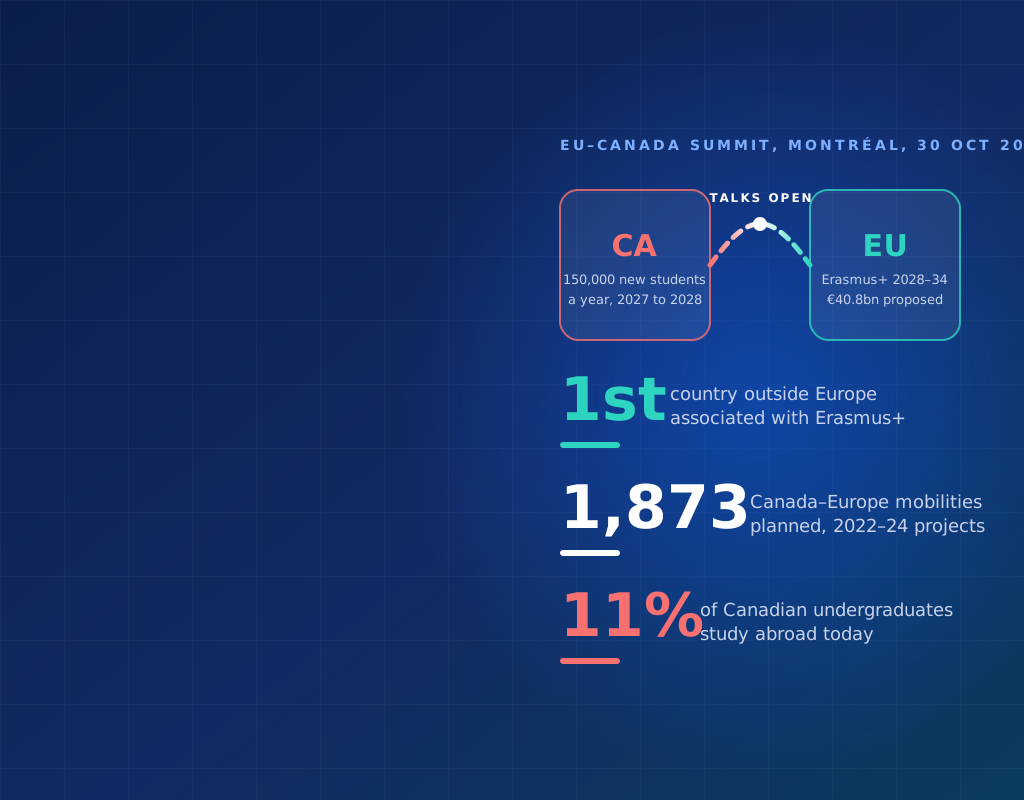
Every few years international education gets a structural announcement rather than a cyclical one. Brexit was structural. Canada's study permit cap was structural. The Montréal summit of 29 and 30 October 2026 may turn out to be one too, because it does not change a quota or a visa rule: it proposes to plug a North American system of more than a million post-secondary students into the exchange architecture that has shaped European higher education since 1987.
For recruiters the temptation is to file it under "nice, but exchanges are not my budget line". That would be a mistake. Erasmus+ money does not buy degree-seeking students, but it buys the partnerships, the semesters abroad and the joint programmes through which degree-seeking students later arrive. The institutions that signed the first Erasmus agreements in the late 1980s are still the ones with the deepest European networks. The same will be true of the first Canadian and European pairs to sign under whatever agreement emerges from these talks.
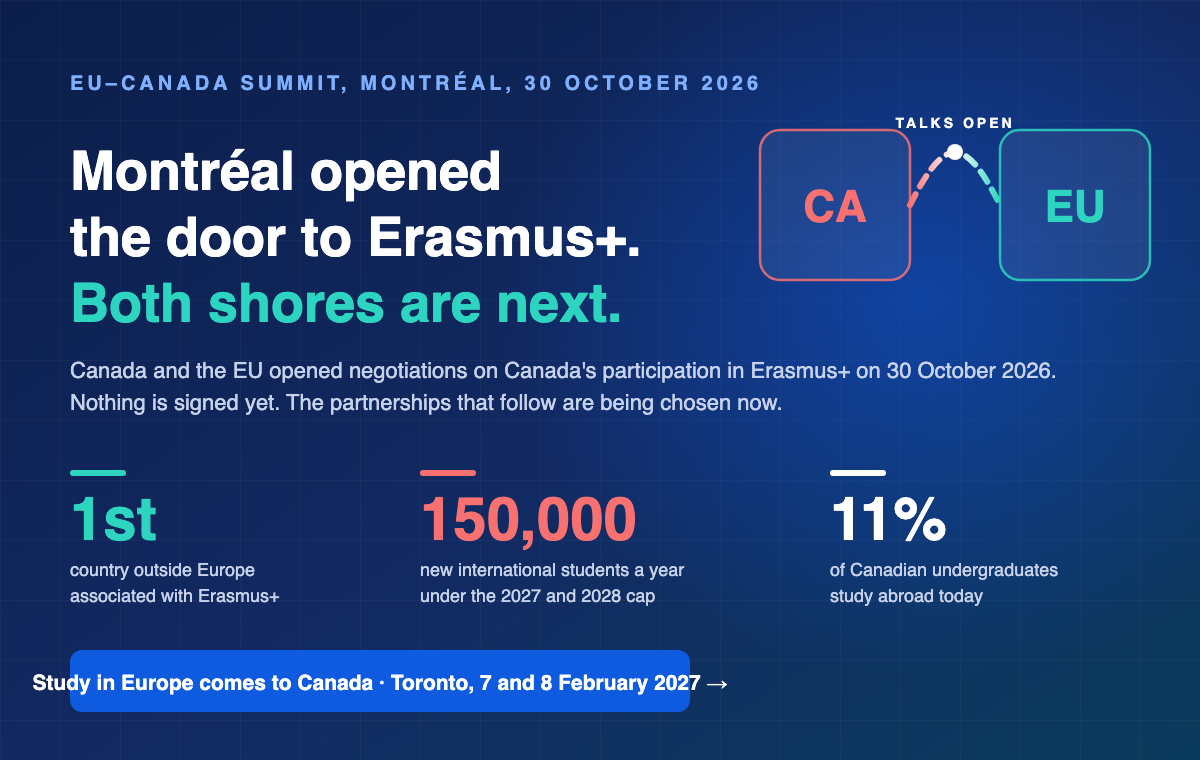
What Montréal Actually Said
The summit produced a joint statement, a news release and a backgrounder from the Prime Minister's Office, a Council of the EU mirror of the statement, and a series of remarks by the two leaders and by the Commissioner responsible for the programme. Read side by side, they give a clear picture of where the file stands, and it is worth putting the sentences next to each other before anyone in your institution forwards the Instagram post.
| The sentence | Who said it | What it means for you |
|---|---|---|
| "Canada and the EU will launch negotiations toward deeper participation in Erasmus+, the EU flagship programme for education, training, youth and sport." | Joint Statement, Canada and the European Union, 30 October 2026 | This is the legal fact. Negotiations are open. Nothing has been requested, signed or ratified, and no timeline is written down. |
| "The goal is to have Canada fully join Erasmus+." | Ursula von der Leyen at the summit, reported by The Canadian Press | The political ambition is full association, not a side door for a few projects. |
| "Canada would become the first state outside Europe associated with the programme." | Roxana Mînzatu, Executive Vice-President, who will lead the EU side of the talks | The EU's own negotiator frames this as association. That is the strongest signal in the file. |
| Canada hopes to join Erasmus+ "midway through 2027" and be a full member of Horizon Europe by 2028. | Unnamed Canadian official, background briefing to The Canadian Press | The optimistic calendar. The European Parliament's rapporteur on Erasmus+ talks about 2028, when the new programme and its budget begin. |
| "Canada's formal request to join Erasmus+ as an associated country." | A European political party's Instagram account | Not the official wording. Useful mostly as a measure of how quickly Europe wants this read as done. |
Two other paragraphs of the statement matter as much as the Erasmus+ line. Canada and the EU will "work toward Canada's participation in future European research and innovation programmes, including Horizon Europe", explicitly the tenth Framework Programme that starts in 2028, and they will "explore a next-generation Youth Mobility Partnership" that names Erasmus+, the European Research Council and the Marie Skłodowska-Curie Actions. Research, youth and education are being negotiated as one package, which is how the Horizon deal of 2024 eventually arrived.
"Canadian membership of Erasmus+ would give your students and ours more opportunity to learn at some of the world's top universities." Mark Carney to the European Parliament, Strasbourg, 17 September 2026.
Why "First Outside Europe" Is the Point
Erasmus+ distinguishes between countries associated with the programme, which can take part in every action on the same footing as member states, and third countries not associated, which can join only certain actions, usually through a European partner. The associated list for 2021 to 2027 is short and entirely European: Norway, Iceland and Liechtenstein through the European Economic Area, and North Macedonia, Serbia and Türkiye as candidates. Canada today sits in the second group, in the same region as the United States.
In practice that means a Canadian university can host or send students under International Credit Mobility only if a European institution applies on its behalf, can join an Erasmus Mundus joint master's as a partner, and can run Jean Monnet activities. The numbers are modest for a country of Canada's size: projects selected between 2022 and 2024 planned 1,007 mobilities from Canada to Europe and 866 the other way, and 91 Canadians won Erasmus Mundus scholarships in four years. The ceiling is not demand. It is the rule that says Canadian institutions cannot apply.
Association removes that ceiling, and the two templates for how it is done are both live this winter. The United Kingdom, which left at Brexit, agreed in December 2025 to rejoin from the 2027/28 academic year at a contribution of about £570 million for the first year, on terms the UK government described as a 30% discount to the default. Switzerland, out since 2014, is one parliamentary vote in December away from re-joining in 2027 at CHF 192.6 million. Neither is a member state. Both show that a bespoke agreement under the current regulation is possible before the new programme begins in 2028, which is why the Canadian official's "midway through 2027" is ambitious rather than fanciful.
There is also a precedent inside the Canada file itself. Canada associated to Pillar II of Horizon Europe in July 2024, committing €99.3 million over four years, after a transitional arrangement that let Canadian researchers apply while the paperwork caught up. New Zealand, South Korea and, since July 2026, Japan have followed the same Pillar II route. Erasmus+ would be the first time that model is extended from research to students.
The sceptics deserve a hearing, because their objections are the negotiation. Alex Usher of Higher Education Strategy Associates points out that an Erasmus exchange student brings a host institution a few hundred euros, while a fee-paying international student in Canada brings around CAD 42,000, and that Canada has no national credit transfer system because credit recognition is a provincial matter. Quebec's premier boycotted the summit on the grounds that education is exclusively provincial. Canada's incoming ambassador to the EU has said Ottawa would be "very selective" about paying into EU programmes. None of these objections stops association; the UK and Switzerland had versions of all of them. But they explain why the realistic date is the start of the 2028 programme, and why the deal will almost certainly be built on exchange students paying home fees, with a National Agency in Canada and the provinces at the table.
What It Changes for a European University
Europe's international offices have spent two years learning to think of Canada as a competitor for the same graduate students, and with reason: Canada's cap exempts master's and doctoral students at public universities, which is exactly the level most European institutions recruit internationally. Association does not end that competition for degree-seeking students. It adds a second relationship on top of it.
- Canada becomes a source of funded exchange students, not only a destination. Only 11% of Canadian undergraduates and 3% of college students study abroad, the federal programme that funded outbound mobility closed in March 2025, and the Prime Minister has made a Canadian semester in Europe a personal talking point. Erasmus+ would pay for that semester. A semester abroad is the most effective master's recruitment event ever devised, and it would be happening on your campus.
- Canadian institutions become direct partners. Today the European side has to carry every application. After association a Canadian university or college could apply to mobility, cooperation partnerships and alliances in its own name. The first memoranda signed under the new rules will set the map for a decade, exactly as the first Erasmus agreements did.
- French-speaking institutions start with a lead. France is the only EU country in Canada's top ten source countries, with 35,430 study permit holders, and Quebec's universities already run deep French networks. Institutions elsewhere in Europe will need presence in Canada to catch up, and presence means being in the room before the money arrives.
- Joint and dual degrees get a funding line. Erasmus Mundus and cooperation partnerships are the natural home for the Canada–Europe double master's that today depend on goodwill and departmental budgets. A dual degree is also the one product that turns an exchange relationship into fee-paying enrolment on the second campus.
- Vocational education is written into the text. The statement names "vocational education and training" and "lasting academic and scientific institutional partnerships". Europe's universities of applied sciences and Canada's colleges, which rarely meet, are both inside the scope.
What It Changes for a Canadian Institution
Canadian international offices have spent the same two years absorbing a 61% fall in new students in 2025, a 2026 allocation of 155,000 new arrivals and a plan for 150,000 in each of 2027 and 2028. Study permit holders stood at 602,115 at the end of August, about a quarter fewer than a year earlier. The growth that the cap removed from volume has to come from somewhere, and Erasmus+ funds precisely the lines that are left: internationalisation at home, outbound mobility, staff exchange and institutional partnerships.
- Diversification with money attached. Every Canadian strategy since 2019 has promised to reduce dependence on two source countries. Association offers 27 member states plus the associated countries as partners, with a European budget that the Commission proposes to raise to €40.8 billion and the Parliament to €47.4 billion for 2028 to 2034.
- Outbound from 11% to something a university can put in a strategic plan. Funded semesters and funded staff mobility are the two things Canadian internationalisation has never had at scale. Both are the core of Erasmus+.
- Inbound Europeans who build the next pipeline. Exchange students pay home fees and cost the host little; what they bring is the dual-degree and graduate pipeline that later delivers fee-paying master's students from the same European partner. For an institution whose undergraduate international intake is capped, that is the route to growth that the cap allows.
- Research is already inside. Horizon Europe association has been running since 2024, with 147 Canadian applications in its first full year, and Montréal committed both sides to Canada's participation in the next programme from 2028. Student mobility would sit on top of a research relationship that exists.
- Colleges are named, not forgotten. The explicit reference to vocational education and training is unusual in a document at this level and is an invitation for Canada's college sector, whose international numbers were hit hardest by the cap.
What It Does Not Change
Honesty about the limits is what will make your briefing credible. Erasmus+ association funds exchanges, partnerships and joint programmes between Canada and Europe. It does not fund degree-seeking students from third countries, so the flows from Brazil, India, Nigeria or Vietnam into either system are not directly affected. It will not be in force for the 2026/27 academic year, and probably not for 2027/28. The cost, the legal vehicle, the role of the provinces and the design of a Canadian National Agency are all still to be negotiated, and Quebec has already said it expects to be consulted. The 2027 EU–Canada summit is the date by which both sides have promised to define what "ever-closer association, short of membership" means.
What it does change, from today, is the conversation. A European recruiter who tells a Canadian partner "our governments are negotiating this; let us be ready" is no longer making a speculative pitch. A Canadian international director who takes the joint statement to a provost has a federal text, a European Commission commitment and a Horizon precedent behind the request for partnership funding. That is more than most internationalisation proposals start with.
What to Do Before the Agreement Exists
- Brief your leadership with the official wording. "Negotiations toward deeper participation", with the Commissioner's "first state outside Europe" as the ambition. Attach the joint statement, not the post.
- Map what you already have. Every International Credit Mobility project, Erasmus Mundus partnership and Jean Monnet activity with a Canadian or European partner is a relationship that converts first when the rules change. Most institutions do not have the list in one place.
- Pick the three partners you want, by department. Erasmus agreements are signed between faculties, not communications offices. Match programmes, calendars and language of instruction now; the legal framework will catch up.
- Design one dual master's. It is the product that turns exchange into enrolment, it is fundable under the actions that already exist, and it will be the showcase when association is announced.
- Be in Canada, or in Europe, in person in the first quarter of 2027. Agreements of this kind are made at institutional meetings, and both continents have them on the calendar. If your institution recruits in Canada, treat the next visit as a partnership trip as well as a student trip.
- Keep the degree-seeking strategy separate. Association is a partnership story. Your fee-paying recruitment in Latin America, Asia or Africa should keep its own budget line, its own events and its own qualified-lead measures, unaffected by this file.
FPP Insight
Strip away the headline and Montréal is good news for both shores, and for the industry that connects them. Europe gains a North American partner that teaches in its two largest languages, shares its view of what student protection looks like, and brings a post-secondary system of more than a million students who have barely begun to travel. Canada gains a funded route to the outbound mobility it has promised for a decade, direct access to 65 European Universities alliances and the budget behind them, and a visible signal to families in every market that the country is diversifying rather than closing. For international education as a sector, a Canada inside Erasmus+ means more transatlantic programmes, more students for whom "Europe" and "Canada" are two stops on one pathway rather than two rival destinations, and a model for how a non-European country can join the world's largest exchange scheme without joining the Union.
The agreement does not exist yet, and the sceptics are right that it will be harder and slower than the summit communiqué suggests. That is the opportunity. The next eighteen months are the window in which European and Canadian institutions choose their partners, and the ones who choose on the strength of the joint statement rather than waiting for the signed treaty will be the ones whose names are on the first agreements.
The first such room already has a date. In February 2027 the European Union's Study in Europe initiative comes to Canada for the first time, and FPP is the organisation chosen by the European Union's Erasmus+ Study in Europe programme, together with Nuffic, to deliver it: a student fair in Toronto on 7 February and an institutional networking day on 8 February, where Canadian universities and colleges meet the European institutions, months before any agreement is signed. It is the second time in a year that the European Union has entrusted FPP with its flagship higher education event outside Europe, after the Study in Europe Fair we organised in India in April 2026. If this article prompts a conversation about Canada in your international strategy, or about Europe in a Canadian one, Toronto is where it continues in person.