
For years, governments have measured the success of international education largely by one metric: the number of international students enrolled.
Estonia's latest data suggests that this may be the wrong metric.
Although the country recorded another decline in international student enrolment during the 2024/25 academic year, the economic contribution of those students continued to grow. Rather than indicating a weakening return on international education, the figures demonstrate that international students remain a highly valuable part of Estonia's workforce and economy.
Fewer Students, Greater Impact
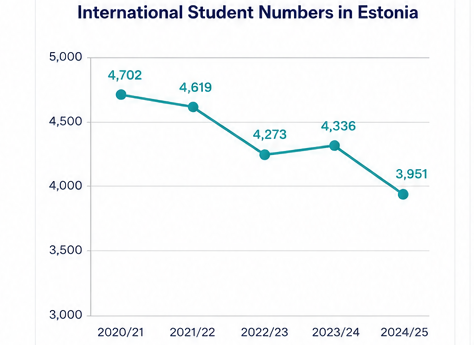
According to Statistics Estonia, the country hosted 3,951 international students during the 2024/25 academic year, down from 4,336 the previous year.
Despite the decline in enrolment, international students paid €16.6 million in labour taxes during the year. When graduates who remained employed in Estonia are included, the total tax contribution reached €24.1 million.
Even more remarkably, international students earned an average monthly gross salary of €1,792, exceeding the average earned by domestic students (€1,646).
This is an important reminder that the value of international education cannot be measured simply by counting student arrivals.
International Students Are an Economic Asset
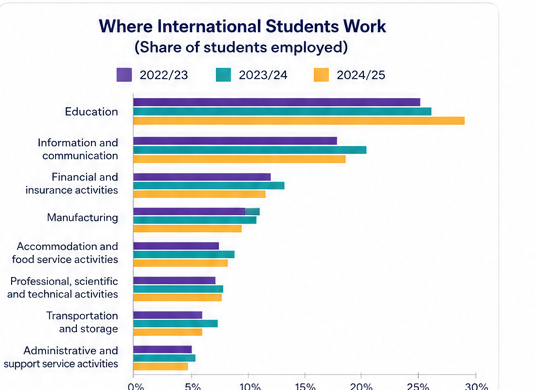
More than half (51%) of Estonia's international students worked while studying, and many remained employed after graduation.
Since 2017, international students and graduates have contributed over €317 million in taxes to the Estonian economy.
These figures reinforce an increasingly important reality: international students are not only tuition-paying learners. They are skilled workers, taxpayers, consumers, innovators and, in many cases, long-term contributors to national economic growth.
A Global Policy Contradiction
Estonia's experience mirrors a broader trend emerging across many destination countries.
Governments in Canada, Australia, the United Kingdom and the Netherlands have introduced policies aimed at slowing international student growth, often citing housing pressures, immigration concerns or infrastructure constraints.
At the same time, official data from many of these countries consistently demonstrates that international students generate billions in economic activity, fill labour shortages and contribute significant tax revenue.
The contradiction is becoming increasingly difficult to ignore.
While public debate often focuses on immigration numbers, economic evidence points in the opposite direction: international students represent a long-term investment in national prosperity.
| Country | Trend | Main Reason |
|---|---|---|
| Estonia | ↓ Students | Migration policies |
| Canada | ↓ Students | Permit caps |
| Australia | ↓ Growth | Visa reforms |
| UK | Slower growth | Dependants policy |
| Netherlands | Slower growth | Government restrictions |
| Germany | ↑ Growth | Active recruitment |
| France | ↑ Growth | National strategy |
The Conversation Is Changing
For decades, universities justified international recruitment primarily through tuition revenue.
Today, that narrative is evolving.
Governments are increasingly evaluating international education through a much broader lens, asking questions such as:
- How many graduates remain in the workforce?
- Which sectors benefit from international talent?
- How much tax revenue do graduates generate?
- How do international graduates contribute to innovation and productivity?
- What skills shortages are being addressed?
These are fundamentally different questions, and they require institutions to demonstrate impact beyond enrolment figures.
The questions governments are now asking go beyond enrolment, workforce retention, sector impact, tax revenue and skills shortages.
What This Means for Universities
For universities and education providers, Estonia's experience offers an important lesson.
Recruitment strategies should no longer be communicated solely in terms of student numbers or tuition income. Institutions increasingly need to demonstrate the broader economic and societal value created by international education.
The strongest case for international recruitment is becoming one based on workforce development, regional economic growth, research capacity and long-term talent retention.
As governments continue reviewing immigration and education policies, the institutions that can clearly demonstrate these outcomes will be better positioned to influence policy and maintain public support.
FPP Insight
International student recruitment is entering a new era.
Success will no longer be measured simply by how many students cross a border, but by the value those students create after they arrive.
Estonia's latest figures provide another compelling reminder that the conversation about international education is shifting, from counting students to measuring impact.
Universities that adapt to this new narrative will be better equipped to engage policymakers, strengthen public support and demonstrate the true return on investment that international education delivers.