
For most of the past three years, the story of international education has been told through caps and quotas. Canada limited study permits. Australia set planning levels. The United Kingdom restricted dependants. The debate was about how many.
August 2026 marked a quieter but more consequential shift. Three destination countries changed the rules in the same window, and none of them announced a new cap. They changed what a student has to be able to pay.
That is a different instrument, and it selects for something different. A cap reduces volume across the board. A financial threshold filters by household wealth, and it does so before an application is ever assessed on academic merit.
Three Rules, One Month
France moved first. From 1 August 2026, applicants for a long-stay student visa must show €877.50 per month for the full duration of their stay, up from €615. It is a 43% increase and the first adjustment in 24 years: the old figure had been frozen since 2002 and pegged to a scholarship allowance that had stopped tracking reality. The new threshold is set at 47% of the gross minimum wage and will be reindexed to inflation at least once a year.
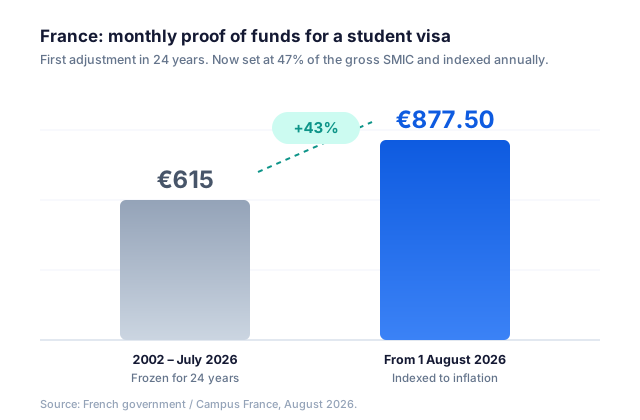
Students can still meet the requirement through savings, a guarantor, a scholarship or another recognised instrument. But for families in Africa, South Asia and parts of Latin America, the gap between €615 and €877.50 per month across a three-year degree is not a formality. It is roughly €9,450 in additional funds that must be visible before a visa is granted.
The United States moved two days later. On 3 August 2026, the Department of State published a final rule making the B-1/B-2 visa bond programme permanent. Consular officers in some 50 designated countries can now require bonds of US$10,000, US$15,000 or US$20,000. The US$5,000 tier was removed. Bonds are refunded when the traveller complies and departs, and forfeited on overstay.
This is a visitor visa rule, not a student one, and that distinction matters. But international education runs on visitor visas too: parents attending graduations, families making campus visits, agents and school counsellors travelling to conferences and fairs. A US$20,000 deposit for a two-week trip changes who shows up.
Iceland moved on the tuition side. Parliament approved legislation requiring students from outside the European Economic Area to pay full tuition at public universities from the 2027/28 academic year. Current students and those starting in autumn 2026 are unaffected, as are non-EEA nationals holding permanent residence. The amounts have not been set: universities must first calculate the real cost of delivering a full-time place, ahead of enrolment opening in December 2026.
A cap tells you how many students a country will take. A financial threshold tells you which ones.
The Bill Arrives First for Whoever Moves First
The United States is roughly a year ahead of the others on this path, which makes it the best available preview of what these instruments cost.
NAFSA's August 2026 analysis with JB International projects up to 111,000 fewer international students in the Fall 2026 intake, taking total enrolment from 1,168,602 to somewhere between 1,056,884 and 1,104,912. That is close to a 9% reduction in a single year, and it carries US$3.4 billion in lost direct economic contribution and nearly 40,000 jobs.
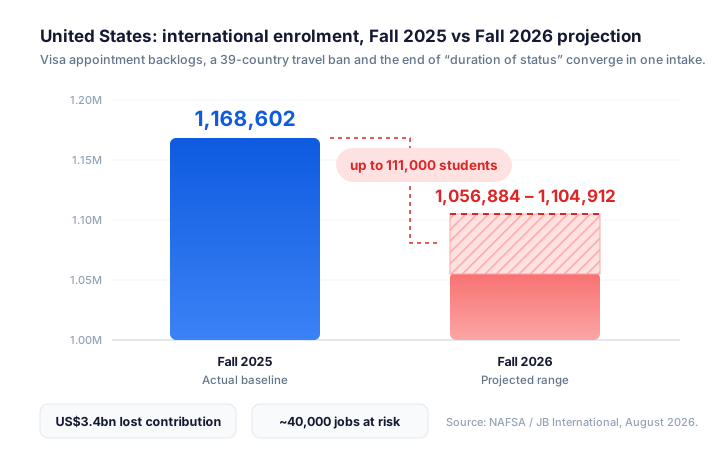
The causes named in the analysis are all procedural rather than academic: limited or delayed visa appointments in India, China and across Europe, with expedite requests frequently denied; a December 2025 executive order restricting nationals of 39 countries with no exception for F student or J exchange applicants; and a final rule published in July 2026 that replaces the long-standing "duration of status" framework with a fixed admit-until date from 15 September 2026, injecting real uncertainty into any degree longer than the admission period. International doctoral applications are already down 21%.
None of these measures reduced the quality of American higher education. They changed the cost and the certainty of getting to it, and demand responded.
Canada Shows What a Sustained Squeeze Looks Like
If the United States shows the first-year effect, Canada shows the compounding one.
Languages Canada's 2025 annual survey, covering 160 member programmes, reported 81,636 students, down 13% year on year. Student weeks fell further, by 19%, to under 799,000. Set against 2019, when members taught 150,112 students and delivered more than 1.5 million student weeks, the sector is now roughly half the size it was before the pandemic.
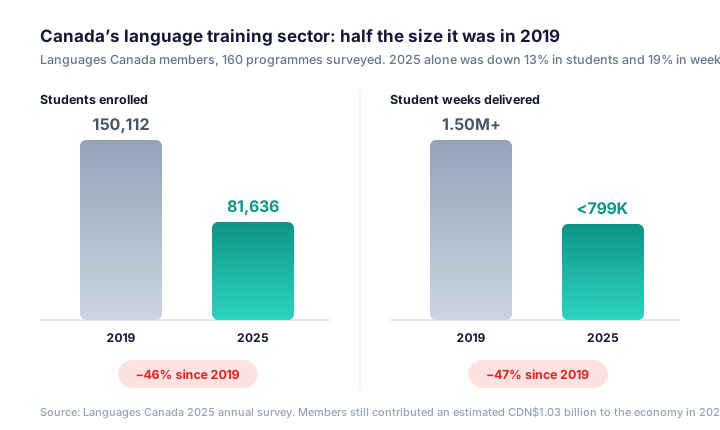
The association describes the sector as being in a state of crisis and attributes the decline squarely to restrictive and unpredictable immigration and visa policy rather than to a loss of interest in Canada. The detail that should give policymakers pause is the one at the bottom of the same report: even at half its former size, the sector still contributed an estimated CDN$1.03 billion directly to the Canadian economy in 2025.
Australia Pulls a Different Lever
Australia is the useful counter-example, because it has kept using the quota instrument rather than the financial one.
Provider-level indicative allocations for 2027 were published in late July, with the National Planning Level held at 295,000 new overseas student commencements, unchanged from 2026. Every public university received the same allocation as the previous year, and no active provider was given a 2027 allocation below its 2026 figure. The adjustments that were made deliberately favour providers with lower reliance on onshore recruitment, and give fairer treatment to recent market entrants.
It is still a constraint, but it is a predictable one. Providers know their number a year ahead and can plan against it. That predictability is itself a competitive asset in a market where the main complaint from every other destination is uncertainty.
Where the Bar Now Sits
| Destination | What Changed | Effective | Who Feels It |
|---|---|---|---|
| France | Monthly proof of funds up 43% to €877.50 | 1 Aug 2026 | All new long-stay student visa applicants |
| United States | B-1/B-2 visa bond made permanent, up to US$20,000 | 3 Aug 2026 | Visitors from ~50 designated countries |
| Iceland | Full tuition for non-EEA students at public universities | 2027/28 intake | New non-EEA entrants, amounts still to be set |
| Australia | 2027 allocations published, national level held at 295,000 | 2027 intake | Providers reliant on onshore recruitment |
| Canada | No new financial rule; 2024–25 permit policy still biting | In force | Language and college sectors above all |
| New Zealand | No new financial barrier; visa processing scaled up | In force | Providers across all sectors, positively |
Demand Did Not Disappear. It Moved.
The most instructive number of the month came from the smallest market in this list.
New Zealand approved 3,501 fee-paying student visas in June 2026, the highest single month in a dataset going back to 2016 and 31% above the same month a year earlier. By the end of June the country hosted 39,738 full fee-paying international students. Nothing about New Zealand's academic offer changed materially in a year. What changed was that it became one of the few destinations where the rules were not being rewritten mid-cycle. A Navitas survey of agents in the same period found students actively considering a wider set of options, with New Zealand scoring highly.
The same widening is visible elsewhere. Greece approved seven new branch campuses of foreign universities. Korea is moving to let its universities accept their own language tests instead of mandating external ones. RMIT is expanding its operations in Vietnam. India's agency association AAERI launched a document verification service to raise the credibility of applications leaving the country.
Students are not withdrawing from international education. They are reallocating toward destinations that are cheaper to enter, faster to process, or simply more predictable.
The Argument Institutions Are Not Making
There is a revealing footnote to all of this. Writing in August 2026, Intead's Ben Waxman reported back from the NACUBO annual meeting, where chief business officers spent several days discussing rising personnel costs, deferred maintenance, enrolment pressure, AI investment and the search for sustainable new revenue.
International enrolment never came up.
In the same period, only 13% of chief business officers said their institution understands per-student programme and activity costs very well. So the people who control institutional budgets are actively hunting for revenue, are not counting international enrolment as part of the answer, and in most cases do not have the cost data that would let them see it clearly.
Governments are pricing international students as a fiscal risk. Institutions have largely stopped pricing them as a revenue strategy. Both sides of that ledger are being argued without the numbers.
What This Means for Institutions and Agents
The practical consequences of a financial gate are different from those of a cap, and they land earlier in the funnel.
- Requalify the pipeline against the new thresholds. A France-bound applicant who qualified in June may not qualify in September. The number moved, not the student.
- Say the financial requirement out loud, early. Discovering a €9,000 shortfall at visa stage costs the family a cycle and the institution a deposit.
- Track processing time as a product feature. New Zealand's record June was won on predictability, not marketing spend.
- Diversify by policy stability, not just by geography. Two markets on the same continent can now sit on opposite sides of this shift.
- Take the revenue case to your own finance office. If international enrolment is not in the institutional revenue conversation, it will not be defended when budgets tighten.
FPP Insight
The border has not closed. It has been repriced.
Caps and quotas are visible, contested and politically expensive. Financial thresholds are quieter: they arrive as a ministerial order, an indexation formula, a bond schedule. They rarely make headlines, and they select on family wealth rather than on student potential.
The evidence from the countries furthest down this road is consistent. Volume falls faster than expected, the economic contribution falls with it, and the money does not reappear somewhere else in the national accounts. Canada's language sector still generated over a billion dollars while losing half its students. The United States is projected to forgo US$3.4 billion and 40,000 jobs in a single intake.
For institutions and their recruitment partners, the strategic question for the next 18 months is not how many students a destination will admit. It is how much a family has to be able to prove before anyone looks at the application, and whether that number will still be the same when the student arrives.